
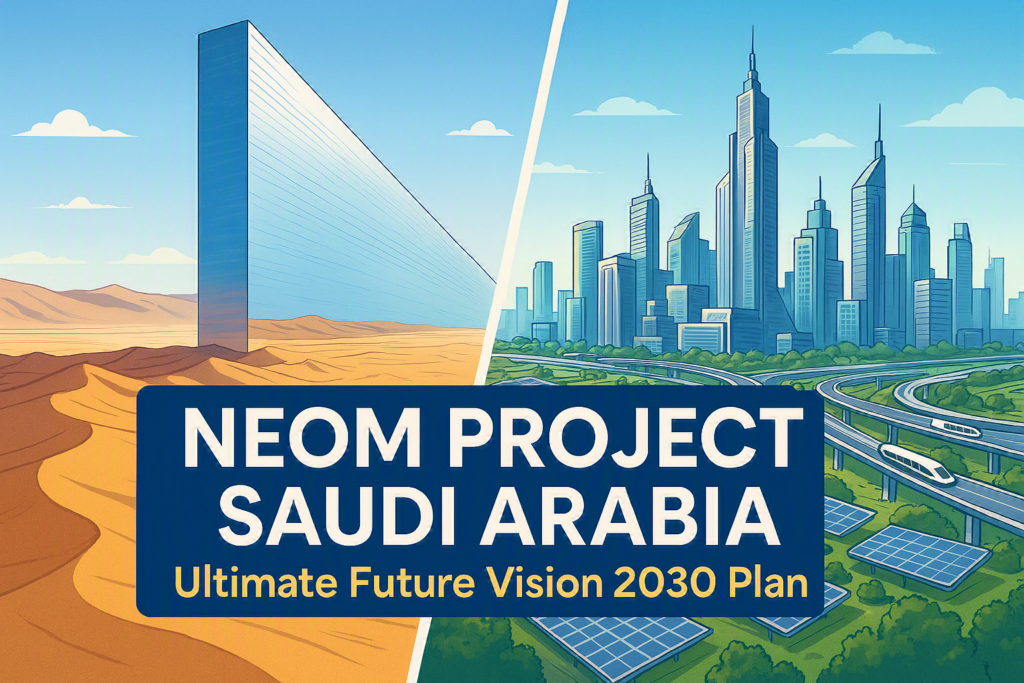
NEOM Project Saudi Arabia: A Bold Vision for the Future
The NEOM Project Saudi Arabia represents one of the most ambitious urban development plans ever conceived. Announced in 2017 by Crown Prince Mohammed bin Salman, this mega-project is a cornerstone of Saudi Arabia’s Vision 2030 strategy aimed at reducing dependence on oil and transforming the nation into a global hub for innovation, sustainability, and technology.
With futuristic ideas such as flying taxis, robot assistants, and a 170-kilometre mirrored city known as The Line, the NEOM Project Saudi Arabia was envisioned as a revolutionary model for future living. However, nearly a decade later, the project faces significant financial and logistical challenges that have led to major adjustments in its execution.

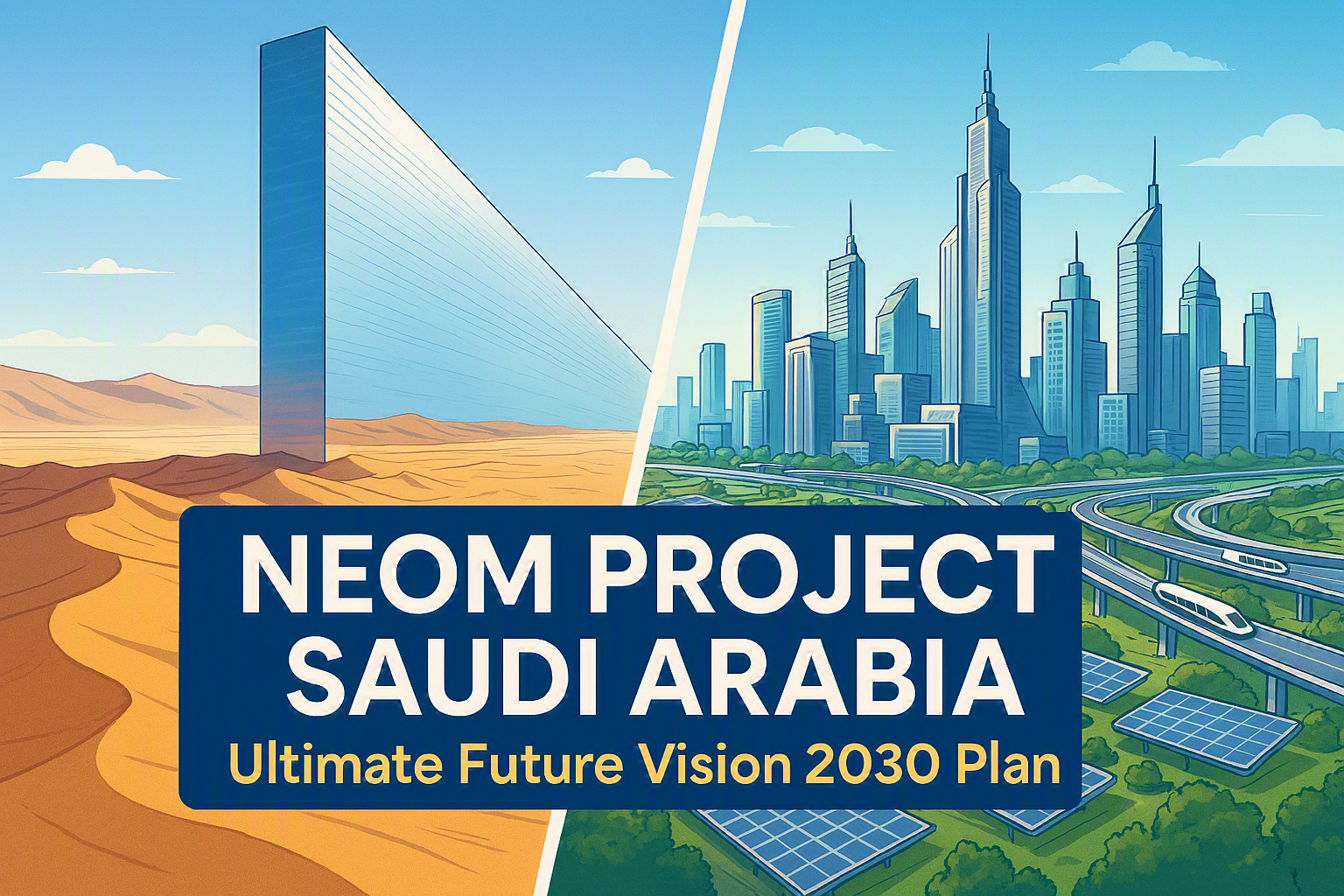
Overview of NEOM Project Saudi Arabia
The NEOM Project Saudi Arabia spans approximately 26,500 square kilometres in the north-western region of the kingdom, along the Red Sea coast. The project includes more than 460 kilometres of coastline and is strategically positioned to connect Asia, Europe, and Africa.
Its primary objective is to diversify Saudi Arabia’s economy by promoting sectors such as:
- Tourism
- Technology
- Renewable energy
- Advanced manufacturing
The region is designed to attract global investors, scientists, and entrepreneurs to create a futuristic ecosystem powered by artificial intelligence and sustainable infrastructure.
Key Developments in NEOM Project Saudi Arabia
The Line – A Revolutionary Urban Concept
One of the most iconic components of the NEOM Project Saudi Arabia is The Line, a pair of mirrored skyscrapers stretching 170 kilometres across the desert and rising 500 metres high.
Key features include:
- Housing for up to 9 million residents
- No cars or roads
- Zero carbon emissions
- High-speed transport connecting the entire city within 20 minutes
The vertical design aims to reduce urban sprawl while improving accessibility and sustainability.
Other Major Projects
The NEOM Project Saudi Arabia also includes several smaller but equally ambitious developments:
- Oxagon: A floating industrial city focused on advanced manufacturing
- Trojena: A desert ski resort designed for year-round tourism
- Sindalah: A luxury island destination for elite travelers
These projects collectively aim to redefine urban living and economic growth in the region.
Cost and Financial Challenges
Initially backed by a $500 billion investment, the NEOM Project Saudi Arabia has seen its estimated total cost rise dramatically. Internal reports suggest the full realization of the vision could cost as much as $8.8 trillion—more than twice Saudi Arabia’s annual GDP.
Reasons for Rising Costs
- Infrastructure development in remote desert regions
- High demand for construction materials like steel and concrete
- Complex technological integrations
- Need for new energy and water systems
These factors have made the project one of the most expensive construction initiatives in history.
Economic Pressures and Shifting Priorities
Saudi Arabia continues to rely heavily on oil revenues, which fluctuate based on global markets. Lower oil prices and production cuts have placed pressure on government finances.
In 2026, the country reported a budget deficit of approximately $33.5 billion. As a result, the government has begun prioritizing projects that deliver faster economic returns.
The Public Investment Fund (PIF), which finances much of the NEOM Project Saudi Arabia, has shifted its strategy for 2026–2030:
- 80% of investments focused within Saudi Arabia
- Increased emphasis on sectors like logistics, clean energy, and manufacturing
- Reduced focus on large-scale real estate developments
Impact of Global Events and Mega Projects
Saudi Arabia’s successful bid to host the 2034 FIFA World Cup has added another layer of financial commitment. The country must invest heavily in:
- Stadiums
- Airports
- Transportation networks
- Tourism infrastructure
These preparations are influencing resource allocation, potentially slowing progress on the NEOM Project Saudi Arabia.
Challenges in Execution: The Sindalah Case
Sindalah, a luxury island within the NEOM Project Saudi Arabia, was intended to showcase early success. Although launched with significant publicity in 2024, the project encountered serious setbacks.
Key Issues Identified
- Construction delays
- Unrealistic timelines
- Environmental challenges such as strong winds and wave conditions
- Incomplete public opening
These challenges highlighted the practical difficulties of implementing ultra-ambitious designs in harsh environments.
Future Outlook of NEOM Project Saudi Arabia
Despite setbacks, Saudi officials maintain that the NEOM Project Saudi Arabia remains central to Vision 2030. However, the approach has evolved:
- Projects are being developed in phases
- Focus on long-term, multi-generational growth
- Greater emphasis on economic feasibility
Finance Minister Mohammed Al-Jadaan described the strategy as a “deficit by design,” emphasizing that large-scale transformation requires patience and sustained investment.
Why NEOM Project Saudi Arabia Still Matters
The NEOM Project Saudi Arabia continues to attract global attention due to its:
- Visionary urban planning
- Commitment to sustainability
- Integration of cutting-edge technology
- Potential to redefine future cities
Even with adjustments, the project symbolizes a significant shift in how nations approach urban development and economic diversification.
For more detials: https://www.neom.com
For more update:https://news24air.com